← Return to Atlas of Yarth

SPIDER GROUP // REGIONAL INTELLIGENCE FILE

Greater Gorblo

Confidential Regional Dossier

Classification: Confidential Region Type: Economic & Political Core Threat Assessment: Low

“Greater Gorblo is a realm of order, prosperity, and relentless expansion, where progress is celebrated, and few pause to question its destination.”

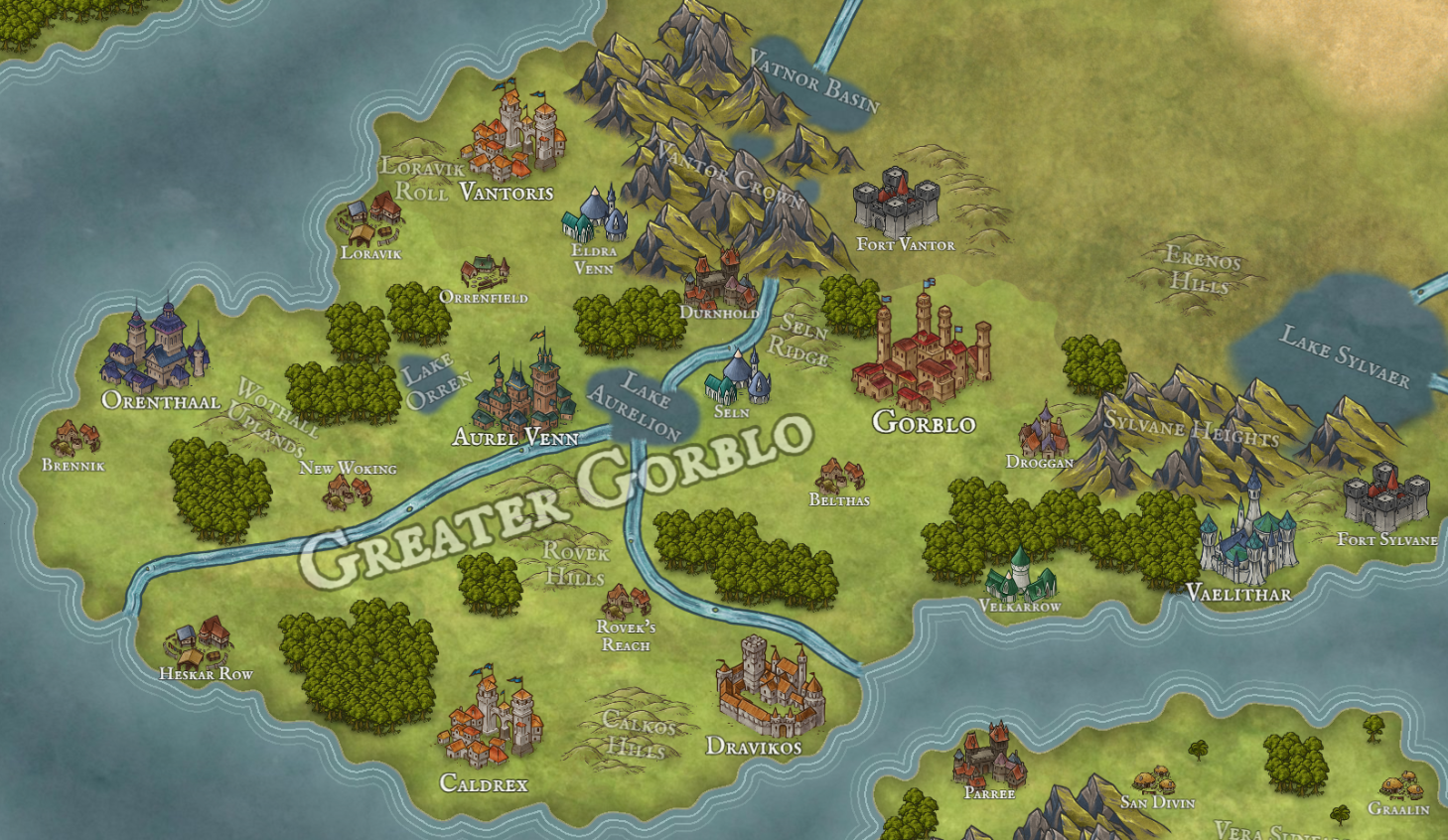
Regional map of Greater Gorblo

Regional Dossier

The following file represents a Spider Group regional assessment of Greater Gorblo, the dominant economic and political centre of Yarth. Sections may be expanded for detailed intelligence notes, settlement summaries, institutional analysis and active rumours.

Overview

Greater Gorblo is the primary economic and political centre of Yarth, located within the central continental landmass and defined by its concentration of large urban population centres and integrated institutional control.

The region is anchored by the city of Gorblo, which functions as the dominant seat of governance, finance, and cultural influence. The region contains multiple large-scale cities operating under a unified but competitive structure, represented through the Gorblo Supreme Council.

Formal authority is distributed, but institutional control remains concentrated within Gorblo, where key administrative, financial, and trade bodies are based, including the central operations of the Guild of Traders.

Greater Gorblo exhibits a highly developed and interconnected economic system, characterised by large-scale infrastructure, consistent trade flow, and dense inter-city connectivity. Settlement distribution reflects planned expansion and economic clustering, supporting sustained influence and territorial reach.

Population is dense and diverse, with goblin populations forming the majority within core urban centres, particularly Gorblo itself. Early foundations tied to goblin autonomy remain culturally significant, though modern identity is shaped by economic dominance, social mobility, and institutional presence.
Geography

Greater Gorblo occupies the south-western portion of the central continental landmass of Yarth, defined by broad plains, coastal access, and elevated boundary ranges. The region’s geography supports high-density urban development and sustained expansion, with terrain that allows for large-scale settlement and inter-city integration.

Natural features include the Vantor Crown to the northwest and the Sylvane Heights to the east, forming elevated boundaries that define the limits of continuous development. These ranges provide natural division between internal territories and external regions, while interior terrain remains largely open, consisting of gently rolling plains and low uplands.

Water systems are central to regional structure. Major rivers traverse the landmass, connecting inland territories to the southern coastline and feeding into key bodies of water including Lake Aurelion and Lake Sylvaer.

Infrastructure such as canals, aqueducts, and subterranean systems are integrated into the terrain, supporting water management and large-scale urban coordination without significant alteration of natural geography.

Travel across Greater Gorblo is extensive, reliable, and largely unimpeded across established land, river, and coastal networks. Airship travel is widely utilised under controlled conditions, linking major cities and external regions through stable, high-density routes.

Settlements

Settlement activity within Greater Gorblo is dense and highly structured, centred around a network of large urban centres supported by secondary towns, agricultural zones, and fortified positions. Development is continuous across much of the region, with settlements linked through integrated infrastructure and sustained economic demand.

Major Cities

  • Gorblo — Capital and primary urban centre. Functions as the political, financial, and cultural core of the region, housing the central institutions of governance, including the Gorblo Supreme Council and the primary seat of the Guild of Traders.
  • Vantoris — Coastal trade metropolis. Serves as a major maritime and commercial hub, supporting large-scale trade operations and acting as a key interface for external economic activity.
  • Orenthaal — Elven-influenced garments and textiles metropolis. Developed through early Second Age elven trade presence, specialising in high-end fabrics, garments, and refined craftsmanship.
  • Aurel Venn — Financial and cultural centre. Functions as the largest centre of banking and large-scale finance in Yarth.
  • Dravikos — Southern expansion city. Developed as a major urban centre supporting territorial growth and internal distribution along southern corridors.
  • Caldrex — Industrial production city. Operates as a primary hub for large-scale manufacturing and logistical support.
  • Vaelithar — Elven-aligned eastern metropolis. Acts as the primary centre of research and development within the region.

Secondary Settlements

  • Loravik — Trade town supporting regional flow between major cities.
  • Eldra Venn — Settlement associated with economic spillover from Aurel Venn.
  • Orrenfield — Agricultural and transit town supporting central supply routes.
  • Durnhold — Major mining town supporting regional raw material supply.
  • Seln — Lakeside settlement and major tourist destination centred on Lake Aurelion.
  • Belthas — Ranching town supporting livestock production and regional supply.
  • Droggan — Historic goblin-founded town with retained cultural identity.
  • New Woking — Urban settlement characterised by administrative overextension and economic instability.

Forts & Installations

  • Fort Vantor — Defensive position controlling access through the Vantor Crown.
  • Fort Sylvane — Eastern fortification monitoring approaches through the Sylvane Heights.
People & Culture

Population within Greater Gorblo is dense, diverse, and primarily urban, with goblin populations forming the dominant demographic across major cities, particularly within Gorblo itself.

Historical origins tied to early goblin liberation remain culturally significant but are no longer a defining social distinction, with goblins fully integrated as the central and governing population of the region.

Cultural norms are driven primarily by wealth, success, and institutional influence. Social standing is closely tied to financial capacity, access to networks, and alignment with major organisations.

Primary language across Greater Gorblo is Common, used for trade, governance, and inter-city coordination. Trade dialects are widespread within major urban centres, while Goblin is used in ceremonial, formal, and high-status contexts. Elven remains in use within cities such as Orenthaal and Vaelithar.

Communication is direct and transactional, with emphasis on clarity, efficiency, and measurable value, particularly within professional and administrative environments.

Government & Power

Governance within Greater Gorblo is centralised but formally distributed, operating through the Gorblo Supreme Council. Representation is allocated based on population, with each major city granted voting influence proportionate to its size.

Gorblo retains additional institutional authority as the founding city, resulting in a structurally weighted system that reinforces its dominant position.

The Gorblo Supreme Council functions as the federal governing body of the region, coordinating policy, trade, and expansion strategy across all major cities. While presented as a unified structure, decision-making is heavily influenced by Gorblo’s central institutions.

The Guild of Traders operates as an embedded power bloc within this system, maintaining legislative control over airship regulation, logistics, and regional transport oversight.

Security and enforcement are divided across jurisdiction. Federal-level crime and inter-regional enforcement fall under Guild authority, while local stability is maintained through city-based guard systems.

Economy & Industry

Greater Gorblo possesses the largest and most integrated economy in Yarth, centred on trade, finance, manufacturing, and administrative coordination.

The Guild of Traders represents the single largest economic organisation in Yarth and serves as the principal coordinator of regional logistics, transportation, and trade.

Economic specialisation is concentrated within the region’s major cities. Aurel Venn functions as the leading centre of banking and finance, Caldrex serves as the primary industrial and airship construction centre, Vaelithar supports research and development, and Orenthaal specialises in luxury textiles and high-value manufactured goods.

Agriculture remains significant but secondary to urban and industrial output. Internal production is supported by surrounding settlements and fertile river systems; however, the region remains partially dependent on imported foodstuffs, particularly from Everbloom.

Major economic influence is distributed across several organisations, including Aerolith Dynamics, the Aetherflow Consortium, Bastion Armaments, the Aurel Banking Syndicate, and the Horizon Development Authority.

Threats & Conflicts

Greater Gorblo maintains a high degree of internal stability, with no major military or environmental threats present within the region itself. Development, trade, and governance continue largely uninterrupted across the majority of settlements.

Internal tension is primarily political in nature. Competition between major cities remains a persistent feature of regional governance, with economic blocs and political interests regularly competing for influence within the Gorblo Supreme Council.

Organised crime remains active despite sustained enforcement efforts by the Guild of Traders. Smuggling operations involving goods, relics, and unauthorised population movement persist along regional and inter-regional routes.

External concerns are centred on economic disruption rather than direct invasion. Instability within the Scorched Lands presents a growing long-term risk through supply uncertainty, refugee pressure, and reduced regional security.

Overall threat assessment: LOW. Conditions remain stable, though increasing external instability, economic migration, and dependence on controlled trade networks present growing long-term risks requiring continued oversight.

Points of Interest
  • Gorblo — Capital and largest city within Yarth; political, economic, and cultural centre of the region.
  • Guild Hall of Commerce — Headquarters of the Guild of Traders and centre of Guild administration.
  • Lake Aurelion — Largest inland body of water within Greater Gorblo, supporting tourism, trade, agriculture, and population centres.
  • Aurel Banking District — Financial quarter of Aurel Venn and home to the Aurel Banking Syndicate.
  • Aerolith Grand Shipyards — Extensive airship construction facilities in Caldrex.
  • Dravikos Security Academy — Major training and recruitment complex for regional security and administrative enforcement.
  • Vaelithar Academy of Arcane Research — Premier research institution within Greater Gorblo.
  • The Grand Exchange of Orenthaal — Luxury commercial district specialising in garments and textiles.
  • Fort Vantor — Mountain fortress positioned within the Vantor Crown.
  • Fort Sylvane — Eastern military fortification overseeing access through the Sylvane Heights.
  • New Woking Civic Complex — Vast administrative centre frequently cited as an example of bureaucratic overreach.
Rumours & Legends

“The Council Votes Before It Meets”

Political observers and minor officials occasionally claim that decisions of the Gorblo Supreme Council are effectively settled before formal debate begins, with voting blocs organised through financial pressure, Guild influence, and private negotiations.

“The Patent Door Opens One Way”

Academic and commercial circles report growing frustration that the Guild of Traders receives preferential early access to transport, logistics, and arcane-industrial patents before wider commercial release.

“New Woking Never Had an Inventor”

Residents and creditors of New Woking circulate claims that the town’s failed magical redevelopment scheme was based on a fictional inventor created to justify public spending, consultancy fees, and administrative expansion.

“The Gold Toll”

Banking houses in Aurel Venn have reportedly objected to a new Guild fee applied to the protected transport of bullion and high-value securities.

“Dorg’s Ledger”

A popular founding story claims that Dorg, the goblin founder of Gorblo, kept a ledger recording every debt owed to those who aided the city’s liberation in the First Age. Some claim the ledger still exists beneath Gorblo’s oldest civic institutions.

``